
 +55 11 2344 7100
 +55 11 99943-9114















































Reflective White Roof
The Ultimate Solution for Thermal Efficiency and Sustainability
The rise in global temperatures has transformed cities into veritable urban heat islands. This is largely due to the replacement of green spaces with dense buildings, dark pavements, and roofs that absorb solar radiation throughout the day. This heat accumulates in the structures and is slowly released at night, drastically raising the temperature of urban environments, increasing energy consumption for air conditioning, and accelerating CO₂ emissions.
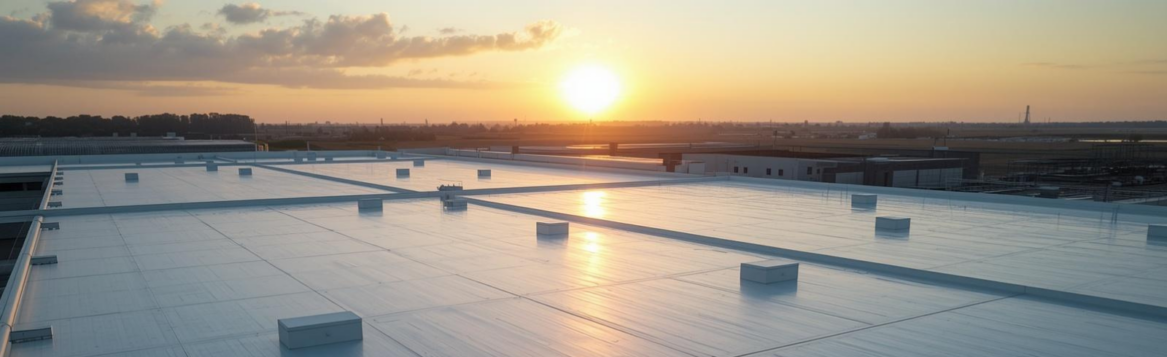
In this scenario of climate urgency, reflective white roofing emerges as one of the most effective, economical, and sustainable strategies to combat building heat and improve quality of life.
How Reflective White Roofing Works to Reduce Heat
Many people think that simply applying ordinary white paint is enough to achieve results. However, this is a dangerous perception. Functional white roofing is not just a color choice, but an engineering solution. It acts as a thermal mirror that reflects most of the solar radiation, preventing this heat from being absorbed by the surface and transferred to the interior of the building.
To be truly efficient, a reflective white roof needs high solar reflectance and high thermal emissivity. Conventional white paints, unfortunately, fail quickly due to degradation from UV radiation, accumulated dirt, and rain, losing almost all of their reflective capacity in less than a year. Therefore, the technology behind the product is what defines a truly high-performance reflective white roof.
Why Technology Is Superior to Simple Painting
Studies conducted by renowned institutions, such as the Lawrence Berkeley National Laboratory in the United States, indicate that adopting a properly technological white roof can reduce city temperatures by up to 1.5°C. Furthermore, reports from the Environmental Protection Agency (EPA) indicate that, if adopted on a large scale, reflective white roofs could reduce global CO₂ emissions by up to 24 billion tons in the coming years.
Research from Columbia University reinforces this thesis, concluding that surfaces treated with the correct white roof technology can reduce air conditioning use in commercial buildings by between 20% and 45%. This data shows that the impact of a reflective white roof is real, measurable, and immediate, both for the environment and for the company’s economy.
Max Therm: The High-Performance Thermal Insulation Certified by IPT
Unlike improvised solutions, Max Therm stands out as the only high-performance reflective thermal insulation in Latin America certified by the Institute for Technological Research (IPT). This scientific certification guarantees that your reflective white roof will maintain the ability to reflect up to 80% of solar radiation and reduce surface heat by up to 75%.
With Max Therm, surfaces that would reach 75°C under strong sun can be kept below 20°C. This efficiency is not just aesthetic; it’s about preventing thermal shock, drastically extending the lifespan of the roof, and ensuring that your investment in your white roof is durable and stable over the years.
Energy Efficiency and Active Sustainability
The direct consequence of implementing a high-quality reflective white roof is a significant drop in operating costs. Companies that invest in this solution report up to a 45% reduction in air conditioning system expenses, less wear and tear on refrigeration equipment, and consequently, less spending on maintenance and machine replacement. The payback on this investment generally occurs rapidly, between 3 and 12 months, depending on the operation.
Furthermore, the white roof is a pillar of active sustainability, contributing to ESG goals and carbon neutrality commitments. By reducing energy consumption, decreasing waste generation from premature tile replacements, and mitigating urban demand for air conditioning, you make your company’s operation an example of environmental responsibility.
A Global Trend in Public Policy
Reflective white roofing is already public policy in several major cities worldwide. Cities like Los Angeles, New York, Chicago, Toronto, Delhi, and Athens already have laws, tax incentives, or heat wave mitigation programs based on the mandatory or incentivized use of white roofing. This is a global trend because the gain is collective: the environment, the city, the consumer, and the company all benefit.
By choosing a white roof with validated technology, you combine operational savings, superior thermal performance, and environmental responsibility in a single smart investment.
📋 Summary
- White roofing goes beyond just color; it demands high reflectivity and technology to prevent degradation.
- Max Therm is the only high-performance insulation in Latin America certified by IPT.
- The investment offers a fast return (payback) between 3 and 12 months.
- A solution aligned with ESG goals, reducing energy consumption and CO₂ emissions.
- Adopted globally as public policy for being the most efficient way to combat urban heat islands.
